

Barbell Buying Guide | How To Choose Right Barbell


Before getting a barbell, it is essential to define the purpose of your exercise, whether you are looking at your barbell for weightlifting, powerlifting or a multi-purpose function. Many people don’t have an idea about how to choose the perfect barbell for them So we come up with a detailed barbell buying guide.
Give this a prompt read to understand your needs and the product which fulfills them, before choosing the right barbell for you!
ANATOMY OF A BARBELL
A typical Olympic Barbell looks like this:

- A Men’s bar is 7.2ft long and weighs 20 kg.
- A Women’s bar is 6.5ft long and weighs 15kg
- A Junior/Training bar is 5.6ft long and weighs 10kg.
OLYMPIC BAR VS GYM ROD

Understanding the difference between an Olympic Barbell and a Gym Rod is crucial.
An Olympic Bar is made up of high-quality steel, designed to hold heavy weights, hence has tight tolerances & freely rotating sleeves that allow the weights to spin when needed.
Whereas the Gym Rods are locally made with cheap Steel rods with no sleeve construction; hence, it has greater tolerances & imperfections, while they are no way suitable for weightlifting or Heavy Powerlifting regimes.
Weight
An Olympic Standard Bar weighs 20kg, whereas a gym Rod has a large margin of tolerance & imperfections, hence can be of any weight between 15kg – 25kg.
Sleeve Rotation
Olympic bars are identifiable by their 50mm, or 2″ ends. In most cases, the sleeves of the bar freely rotate. When you practice Olympic lifts or other CrossFit lifts, the rotation of the sleeve aids in reducing the level of torque created by the weight plates.
The revolving ends on Olympic barbells allow the weights to spin freely, reducing the amount of torque and the strain on your wrists/shoulders.
The amount of spin of the bar is determined by whether the bar rotates on bushings or bearings.
Sleeve and Shaft Diameter
Gym Rods are the full width of anywhere from 25mm to 29mm. While the main shaft of an Olympic bar would be 28mm, the end sleeves on Olympic bars are 49.8mm (~2 inches) in diameter.
A good quality Olympic bar will have a consistent sleeve diameter with minor to no variation, whereas a cheap bar can have up to 2mm variance in diameter from 49.8mm.
FACTORS TO BE CONSIDERED WHILE EVALUATING A BARBELL
Barbell Knurl
The cross-hatch pattern of grooves on the shaft is known as Barbell knurling or knurl. It digs into your palm & increases the friction between your hand and the barbell, which provides you with the best possible grip depending on the type & aggressiveness of the knurl.
The grooves’ width and depth will determine how “aggressive” the knurl is. More depth with favorable width means a more aggressive knurling & hence a stronger grip. Hence 1.5mm knurl is a much more aggressive knurl than 1.2mm & followed by a 1.0mm knurl.

Among them, the Volcano knurl pattern is the most optimal. It has more points per square inch which increase the surface area for friction & digs extremely well but do not rip the palm skin. Hence most powerlifting barbells come with a 1.5mm volcano knurl pattern.
Knurl Markings: The Knurl markings are the 5mm thick circled markings present on the barbell’s shaft, which are placed according to IPF or IWF specifications.
- IPF knurl marking is used to recognize the widest grip allowed in the bench press.
- IWF knurl mark is used to recognize the widest grip allowed in the snatch.
Center Knurl: The Centre knurl is an essential factor for squatting, as it helps to keep the bar in place on your back during back squats & on your chest during the front squat.
Barbell Coating
Different types of barbell coating affect the knurl feel and the oxidation resistance of the bar, which are
- Black Oxide
- Chrome: Bright chrome
- Hard chrome
- Ceramic coating
- Stainless Steel Barbell

Black Oxide Barbells
The grip of a Black Oxide coated bar provides you with the best feeling that is near to a “Bare steel” experience. To keep aggressive knurl alive, a thin layer of coating is applied, which is economically achieved by Oxide coating, but this provides very less to mild protection against oxidation. Hence, it should be noted that regular maintenance is required with a frequency of 15-45 days to protect from oxidation, depending on climate conditions and geographical location.
Chrome (Bright Chrome)
Chrome is a Budgetary option that can withstand a better oxidation resistivity than oxide. It has a pretty bright finishing look & allows a moderate knurl feel the experience. With time, there might be a chance of the coatings beginning to chip off or peel off & may lose their oxidation resistance, which tends to rust the bar.
Hard Chrome
Hard chrome proves to be an ideal choice for Commercial facilities because of its silver finish look, low maintenance, moderate knurl experience & more than moderate oxidation resistance.
Ceramic Coating
It offers up to 100x the corrosion resistance of a standard black oxide/phosphate coat. Since the ceramic provides a near-to-perfect rust resistance, it’s hassle-free towards maintenance & comes with an aesthetic matt look. The only drawback is that it could be scratched with any metal-to-metal contact (while racking the bar on bare J-cups), but if you are using UMHW Plastic J-cups, then this bar can last for years.
Stainless Steel Barbell
If you’re living in coastal areas or facing harsh winters, have humidity and moisture bring in rust between you and the barbell, increasing your frequency of maintenance, stainless steel barbells come to your rescue.
Compared to all the above-mentioned types of coatings on bare steel, stainless steel gives you a superior finish and durability.
Sleeve Construction
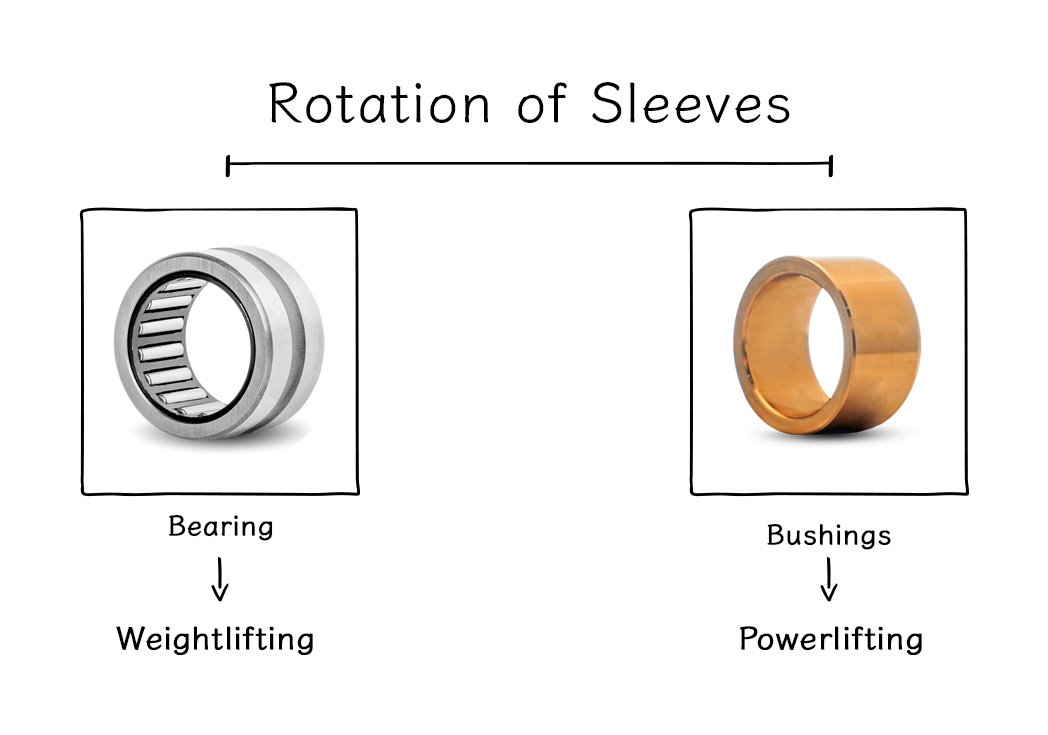
Spinning mechanisms vary on the sleeve construction of the bar, depending on if they have Bearings or Bushings.
Needle bearings are designed to provide smooth, consistent, and quieter spin to match the needs of weightlifting. Whereas, Bushings are constructed to provide the optimum (less to moderate) spinning mechanism required for powerlifting.
Conclusively, If you’re into Weightlifting or CrossFit training, you should go with a bar that has Needle Bearings, while If you’re into powerlifting regimes, you should go with a bar that has bushings.
Note: BullrocK’s Proprietary Bushes, the one used in our Black Panther model, are economically constructed to provide the optimal spin into weightlifting workouts; hence they are different from regular bushes used in most power bars. In comparison, you will not see these proprietary bushes within our premium bars since Needle bearings stand far ahead of any of these bushes regarding weightlifting olympic barbells.
Shaft Diameter
The IWF (International Weightlifting Federation) specifies the bar must be 28mm for men & 25mm for women & youth, unlike the IPF (International Powerlifting Federation) only specifies the bar must be within 28-29mm grip diameter.
Hence our Olympic bars come with a 28mm diameter for men & 25mm barbell for women, while Power bars generally come with a 29mm diameter since practically 29mm is a more convenient & efficient grip than 28mm for bench & squat.
Whip
Purpose: To introduce momentum into the lifts caused by the bar.
Weightlifting: Whip Desired
Powerlifting: Whip Not Desired
Some serious deadlifters may disagree since they prefer great whip while lifting off the weight.
Barbell Strength
The barbell is associated with two technical parameters which should be known while choosing one.
- Yield Strength: It signifies how much weight you can put on the barbell while the bar is hanging in the rack without it bending permanently.
- Tensile Strength: The maximum load your bar can support without fracturing or breaking. This is rated in pounds per square inch (PSI).

TYPES OF BARBELLS
Barbells can be followingly categorized according to the type of exercises performed using them.
- Powerlifting Barbells
- Multi-Purpose Barbells
- Weightlifting Barbells
- Specialty Barbells
Powerlifting Barbells
There are three core or main lifts of any powerlifting workout regime- Squat, Bench Press, and Deadlift. There are several other variations of these main lifts, such as Front Squat, Back Squat and different deadlift forms.
According to IPF (International Powerlifting Federation) specifications, the diameter of the barbell shaft is not to exceed 29 mm or be less than 28 mm.
Power bars generally come with a 29mm diameter since they provide more surface area for contact hence becoming more convenient. For bench and squat, an efficient grip is 29mm in diameter.
The grip plays an important role in powerlifting, and the knurl pattern on your barbell plays a detrimental role here.
When it comes to serious Powerlifter, the aggressiveness of the knurl must be considered based on the type of grip you prefer/follow for Deadlifts, i.e., Hook Grip, Mixed Grip or Overhand Grip.
In case you prefer Hook Grip, then a 1.2mm knurl is optimally well suited for you because a 1.5mm aggressive knurl could be difficult for most people for the long practice of hook grip.
For the lifters who prefer Mixed or Overhand grip, deadlifts can go with 1.5mm, which provides you with a strong & aggressive grip of a bar.
A powerlifter should ideally go with a bar having bushings to provide the optimum (less to moderate) spinning mechanism required for power lifts because powerlifting consists of vertical push and pulls movements that do not require a high spinning mechanism. A whip is not desired in a Powerlifting Barbell unless for those who prefer whip in deadlifts.
Center Knurl: The Centre knurl is an essential factor for squatting, as it helps to keep the bar in place on your back during back squats & on your chest during the front squat.
Weightlifting Barbells
Weightlifting emphasizes on two kinds of lifts- Snatches, and Clean and Jerk. Both of these require full limb extension to acquire a greater range of motion and, at the same time stability.
IWF (International Weightlifting Federation) specifies a shaft diameter of 28mm for men & 25mm for women & youth.
A weightlifting bars should have needle bearings that are designed to provide smooth, consistent, and quieter spin to match the needs of the weightlifting. To perform the snatch and clean & jerk for lifting maximum load efficiently with a reduced risk of a wrist injury.
Weightlifters have to consider and precisely catch the momentum of a bar efficiently during 1st phase of the lifting motion. A barbell having “whip” allows the lifter to introduce momentum into lifts, which should be caused by the bar, & not by them. A skilled lifter makes use of the whip to propel the weight upward, e.g. During the clean and jerk, they can bounce the bar off their chest and propel the bar upwards by using the momentum of the flex coming upwards into the jerk position.
Multipurpose Barbells
If you are not a specialized lifter, or are more of a recreational lifter, or are working in your home gym, multi-purpose bars prove to be of great use.
A bar for multi-purpose should be ideally 20kgs and 7.2ft long. To cater to both powerlifting and weightlifting exercises, 1.2mm deep knurling suffices. A multi-purpose bar may have a centre knurl which aids in front and back squats in powerlifting exercises.
If your training regime is of less intensity and high repetitions, or you are an occasional weightlifter, proprietary bushings serve the purpose. Whereas, If you are a weightlifter and lift heavy weights every day or more frequently, bearings are recommended. Also, the whip is recommended if you are eying for multi-purpose since it’s a requisite in weightlifting, and some powerlifters prefer it, especially while deadlifting.
Specialty Barbells
Specialty Barbells are exactly meant for what they are called- A specialty. To target specific muscles or to focus on particular strength qualities. They ensure versatility ensuring versatility in your training across all areas of weight training. Specialized Barbells are great not just for specialized training but also help you to work around injuries, target specific body parts or focus on particular strength qualities. Variants of the trusted barbell can be brought into play to supercharge your training.
CONCLUSION
BullrocK Fitness offers you a wide array of barbells that serves almost every requirement in different capacities.
We also provide a ‘consult with expert’ service wherein we give you expert guidance and a comprehensive view of BullrocK Barbells.
| Weightlifting | Powerlifting | Multipurpose (Weightlifting + Powerlifting) | Specialty | Utility/Curls bar | ||
| The Black Panther Bar – Bearing Claws | The Black Hound Bar | The Black Panther Bar – Bearing Claws | The Squat Bar | The Utility Bar – EZ Curl (Hard Chrome) | ||
| The Red Turtle Bar | The Sabertooth Bar | The Red Turtle Bar | The Deadlift Bar | The Utility Bar – EZ Curl (Chrome) | ||
| The Silver Tiger Bar 2.0 | The Black Panther Bar – Bushing Claws | The Lady Turtle Bar | Multi Grip Bar | The Utility Bar – EZ Curl Black Edition (Ceramic) | ||
| The Silver Tiger Bar – Hunter Edition | The Wild Rhino Bar – Bossy Blue | The Junior Bar | The Safety Squat Bar | The Utility Bar – EZ Curl Black Edition (Oxide) | ||
| The Silver Tigress Bar | The Wild Rhino Bar 1.5 | The Silver Tigress Bar | The Hex Trap Bar | The Utility Bar – Straight Curl – 4 Feet | ||
| The Lady Turtle Bar | The Deadlift Bar | The Utility Bar – Straight 5 Feet | ||||
| The Junior Bar | Multi Grip Bar | |||||
| The Hex Trap Bar | ||||||
| The Squat Bar | ||||||
| The Safety Squat Bar |